

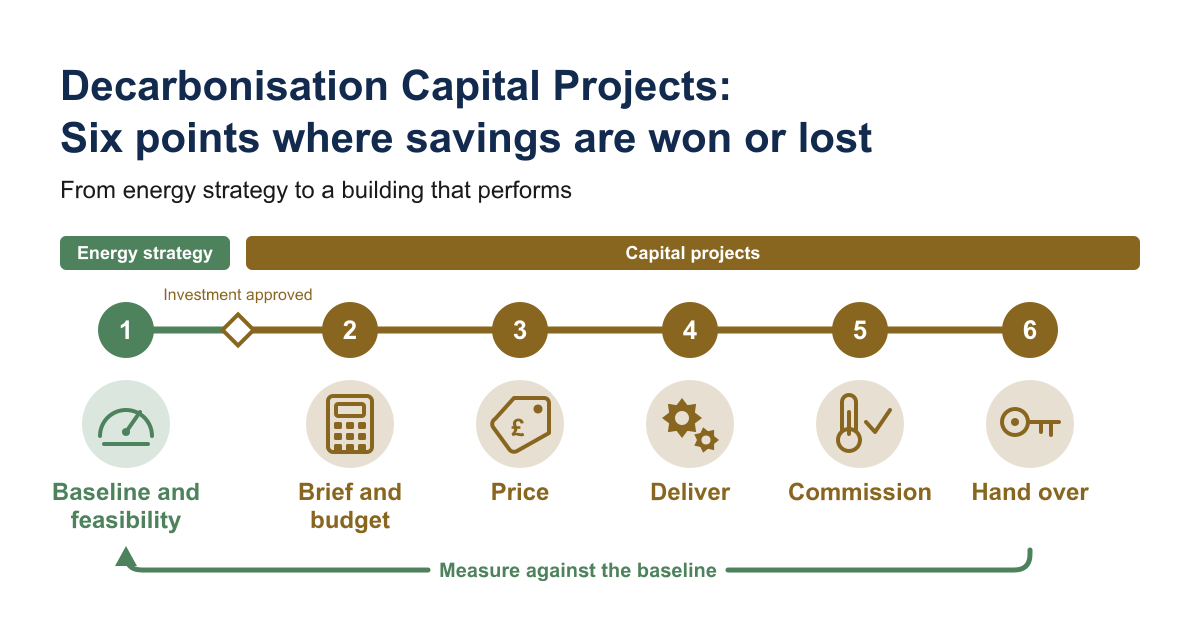
Decarbonisation Capital Projects:
From Energy Strategy to Delivered Works
Most estates now have a plan for reducing energy use and carbon. Fewer have a clear route from that plan to plant that is installed, commissioned and still performing two winters later.
Our staged approach to decarbonisation capital projects sets out how to sequence that investment, starting with data and quick wins before committing capital. This piece picks up where that one stops, at the point where the investment becomes a capital project. The decisions taken between approval and the first heating season are what decide whether the savings in the business case ever appear.
Why these projects behave differently
A decarbonisation scheme is not a like-for-like replacement, even when it looks like one on a drawing.
The most common surprise is the distribution system. A system that worked with gas boilers cannot be assumed suitable for heat pumps. Radiators and heating coils need checking at the proposed operating temperatures, and pipework, pumps and valves have to cope with any change in water flow rates. The condition inside the system matters too. Corrosion and sludge affect heat exchangers, pumps and valves even where the installation looks perfectly serviceable from the outside.
Finding this late means cleaning, repairs or replacement, with the cost and disruption that follow. The practical lesson is simple: investigate what you intend to keep before you fix the scope and the programme.
That investigation starts with knowing how the building performs today. If you have not done it yet, an energy performance self-assessment is a reasonable first step. It is also worth being clear about where you are in the process, because these schemes often compress the early design stages. Our guide to RIBA stages explains what should be resolved before a project goes to market, and what it costs you when it is not.
Check the electrical supply before you choose the plant
An electrical supply upgrade is not automatic on a heat pump scheme, but checking capacity should be part of every feasibility assessment.
You need to establish existing demand, available capacity and the proposed additional load before committing to equipment, budget or programme. Both the building’s own electrical distribution and the incoming network supply need to be considered, and the distribution network operator should be engaged early.
At Larkfield Leisure Centre, our decarbonisation works included upgrades to the incoming electrical infrastructure, and dependencies on the network operator affected the programme. Electrical capacity is an early project decision, not a detail to resolve once the heat pumps are on order.
What the brief and the budget need to say
What you are buying is a performance outcome, not a piece of equipment. The brief should say what the system is expected to achieve, measured against a baseline, rather than simply naming the technology.
The budget then has to cover the whole scheme, including the enabling works. Electrical infrastructure, emitters, pipework, storage and controls are all part of the cost of a heat pump project, and they are the items most often left out of an early estimate.
At The Weald Sports Centre, the existing air handling unit coils had to be replaced as part of the decarbonisation works. That is a good illustration of why the assessment has to extend beyond the new heat source to the equipment that actually delivers heat around the building. Identify those requirements early and the replacement cost, procurement and installation sit inside the budget and programme, instead of arriving as additional work once the scheme reaches site.
The principles here are the same as any capital scheme, and our piece on design and costing covers them in full. For the public sector financial case specifically, energy management in local authority buildings looks at how to build one that holds up to scrutiny.
Pricing a scheme when the existing conditions are uncertain
Uncertainty is priced. If a contractor cannot see the condition of what they are connecting to, the risk allowance goes up, or the risk comes back to you later as a variation.
The way to reduce that is survey work before you go to market, not after. The more completely the existing system is understood, the more routes to pricing work in your favour, and the more useful the conversation about who carries the risk of what is already in the building. Understanding contractor pricing helps here too, because it explains why two prices for the same scheme can look so different.
Be careful with performance. Where a contract attaches guarantees to energy or carbon outcomes, be clear about what is being guaranteed and under what operating conditions, because building use changes and performance claims are hard to enforce when it does. Our guide to construction contract terms covers the clauses worth questioning before you sign.
Keeping the building running through the changeover
Most of these projects happen in buildings that cannot close.
At The Weald Sports Centre, detailed design and planning protected heating and hot water provision while heat pumps, new hot water storage and upgraded controls were introduced. Keeping the centre operational was a requirement built into the design, rather than a problem handed to the site team to solve once work started.
That is the transferable lesson. Agree the changeover sequence and the service continuity arrangements before work begins, so everyone knows how each stage will operate. Our piece on capital project delivery in live environments covers the wider phasing and disruption planning, and capital project stakeholder management deals with the communications side, which on these schemes includes the funding body as well as building users.
Commissioning is where the savings are won or lost
Good commissioning proves that the whole system works together, not just that the heat pump starts.
It begins during design, with clear performance requirements and enough time in the programme for testing. On site, the water system needs to be clean, tested and balanced, with the required flows demonstrated and the results recorded. The controls are then tested against the intended operating strategy: adjusting heating temperatures to suit outdoor conditions, sequencing multiple units, managing hot water demand, and checking when any backup heat source operates. Air source systems also need the right arrangements for maintaining service during defrost. These functions have to work as one coordinated system.
Commissioning should then continue into operation, through monitoring and seasonal adjustment. Heat and electricity metering tell you whether the installation is delivering the expected performance, which a successful start-up test does not.
When this is rushed, the building can still feel warm while the system performs badly. Heat pumps start and stop too often, or backup heaters run more than intended. Energy use and running costs go up, which undermines the point of the investment. The questions in capital project practical completion are worth asking before you accept the works, and the control faults we find in BMS optimisation surveys are very often ones that were set in at commissioning and never revisited.
Handover: giving the FM team something they can run
The difference at handover is not more manuals. It is a shared understanding of a different operating strategy.
A boiler replacement still needs proper drawings, commissioning records and operating instructions. With low carbon plant, the FM team also needs to understand how the heat pumps, distribution, storage and controls are meant to work together. The handover should explain the intended temperatures and schedules, how weather compensation works, when backup heating is permitted to run, and how heating and hot water demands are prioritised. The team needs to know which settings it can adjust, and which changes will quietly damage performance.
Practical training should come with access to the building management system and energy monitoring, an agreed record of the final settings, and a seasonal review plan, so the team can tell when performance starts to drift. Maintenance requirements also have to reflect the technology installed, including manufacturer specific servicing, outdoor airflow, filters, controls and specialist support.
We build this into how we approach completion on energy and capital projects. The aim is not to hand over documents. It is that the team leaves handover knowing what normal operation looks like, what the warning signs are, and who to call. Capital project handover covers how this connects to your maintenance strategy, and energy KPIs are a practical way to keep measuring afterwards.
One team from audit to aftercare
Decarbonisation work sits awkwardly between disciplines. The energy assessment, the capital delivery and the ongoing maintenance are often three different organisations, and the gaps between them are where performance is lost.
At Rye, Winchelsea and District Memorial Hospital, an energy audit turned into a coordinated programme of capital improvements, combining solar PV and battery storage with electric flow boilers, a new building management system, LED lighting, upgraded fans and pumps, and electrical metering. It shows how several targeted measures can work together to improve a building’s performance, rather than relying on one technology to do everything.
If you have decarbonisation work in your capital plan, we would be glad to talk it through before the scope is fixed. You can see how we deliver capital projects and energy and sustainability work, or talk to the team.