

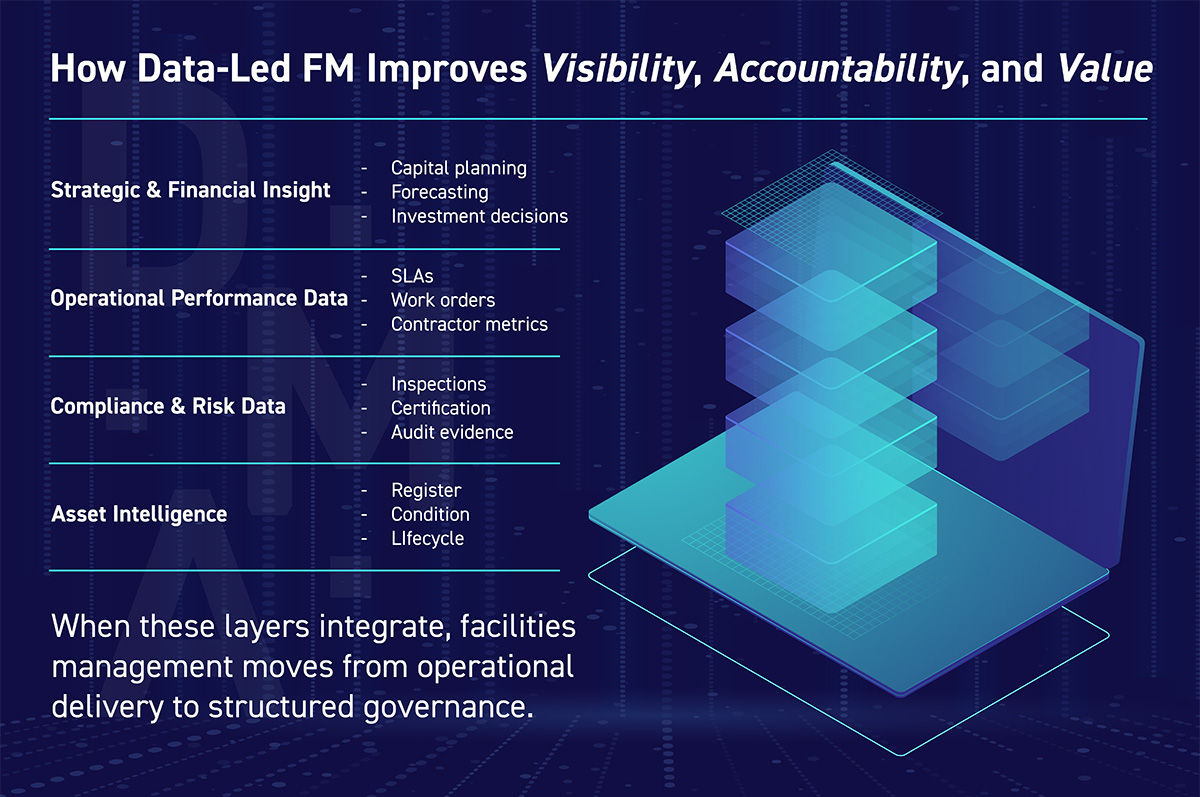
How Data-Led FM Improves Visibility, Accountability and Value
Facilities management in 2026 is no longer defined by activity alone. It is defined by visibility, accountability and long-term estate value, supported by clear, evidenced control.
Data-led FM provides the structure behind that clarity. When asset, compliance, operational and financial data are integrated properly, estates teams move from reactive delivery to informed decision-making.
This guide explores the four core layers of facilities management data, and how, when combined, they transform estates from operational functions into strategic assets.
What Does “Data-Led FM Actually Mean?
Outcome One: Visibility
Outcome Two: Accountability
Outcome Three: Value
The Visibility Gap in Facilities Management
Facilities management has never been more scrutinised.
Across education estates, healthcare environments, commercial property portfolios and multi-site organisations, expectations have shifted. Boards want assurance. Regulators expect traceability. Senior leaders require evidence. Finance teams demand predictability.
Yet many estates functions are still operating with partial visibility.
Not because they lack commitment. Not because they lack competence. But because their data is fragmented.
Spreadsheets still live in different folders. Compliance certificates are stored in inboxes. Asset registers are incomplete. Work orders are logged but not analysed. Reporting is retrospective rather than predictive.
Activity is high. Insight is low.
In 2026, that gap becomes a governance issue.
The question is no longer: “Are we doing the work?” It is: “Can we evidence control?”
Data-led facilities management addresses this shift directly. It replaces anecdotal knowledge with structured insight. It transforms operational noise into decision-making clarity. It enables estates teams to demonstrate not only what they are doing, but how effectively they are managing risk, cost and long-term value.
At its core, data-led FM delivers three outcomes:
- Visibility
- Accountability
- Value
Together, these outcomes are another aspect to defining what good facilities management looks like in 2026
What Does “Data-Led FM” Actually Mean?
The term “data-led” is frequently used but rarely defined clearly.
It does not simply mean having CAFM software. It doesn’t mean generating more reports, and it doesn’t mean collecting information for its own sake.
Data-led FM means structuring, integrating and using operational data to inform decisions at every level of the organisation.
Data-Led vs System-Led
Many organisations are system-led. They log jobs. They close tickets. They upload certificates. They generate monthly reports.
But logging activity is not the same as extracting insight.
A system-led approach focuses on recording what happened.
A data-led approach focuses on understanding what it means.
For example:
- A reactive repair is logged.
- A data-led model identifies that the same asset has failed three times in twelve months.
- That insight triggers lifecycle review and capital planning.
The difference is structural.
From Reactive to Predictive
When operational data is centralised and structured correctly, trends become visible:
- Recurring asset failures
- SLA performance drift
- Seasonal demand spikes
- Compliance bottlenecks
- Cost anomalies
Instead of discovering problems during audits or breakdowns, estates teams can identify risk patterns early.
Predictive maintenance is not futuristic. It is the logical result of properly analysed historical data.
This shift is already underway. In 2024, 59.1% of FM leaders said they were excited to apply AI to existing processes (DMA Group Industry Survey).
The appetite is clear. The challenge is data maturity. AI cannot deliver insight if operational data is fragmented, inconsistent or incomplete.
The Four Layers of FM Data
Data-led FM operates across four integrated layers:
- Asset Data – what you own
- Compliance Data – what must be maintained
- Operational Data – what is happening daily
- Financial & Strategic Data – what it means for the organisation
When these layers connect, visibility becomes strategic, not administrative.
Outcome One: Visibility
Visibility is the foundation of control.
Without visibility, organisations operate reactively. Decisions are based on memory, experience and assumption. Risk becomes visible only when something fails.
With visibility, estates teams gain clarity across operations, compliance and long-term planning.
Operational Visibility
Operational visibility answers:
- What jobs are open right now?
- Which SLAs are at risk?
- Where are backlogs forming?
- How is the supply chain performing?
In a data-led environment, this information is live and structured. Overdue actions are flagged automatically. Performance metrics are measured consistently. Bottlenecks are identifiable before they escalate.
Without operational visibility, firefighting becomes normalised. With it, proactive management becomes possible.
Asset Visibility
Asset visibility extends beyond a static register.
It includes:
- Accurate asset tagging
- Installation dates
- Condition assessments
- Maintenance history
- Replacement forecasting
This enables estates teams to see patterns across buildings and portfolios. Age profiling supports capital planning. Maintenance history supports performance analysis. Replacement cycles become predictable rather than reactive.
An incomplete asset register is not simply an administrative weakness; it is a strategic blind spot.
Compliance Visibility
Compliance remains one of the most scrutinised areas of FM.
In 2026, organisations are expected to demonstrate:
- Real-time compliance status
- Digital certification records
- Scheduled inspections
- Evidence traceability
- Clear accountability
Compliance should never be “discovered” during an audit.
Data-led FM ensures inspection schedules are automated, certificates are stored centrally, and risk alerts are visible before regulatory scrutiny occurs.
Visibility turns compliance from a reactive audit exercise into a structured governance function.
Outcome Two: Accountability
Visibility alone is insufficient. It must lead to accountability.
Accountability in facilities management is not about blame. It is about clarity of responsibility, measurable performance and traceable decision-making.
Clear Ownership
In a data-led FM model:
- Every task has named ownership
- Escalation routes are defined
- Completion is digitally recorded
- Approval processes are documented
This removes ambiguity. It ensures nothing “falls between departments”. It reduces reliance on individual memory.
When responsibility is visible, performance improves.
Measurable Performance
Accountability requires metrics.
Data-led FM enables consistent tracking of:
- Response times
- First-time fix rates
- SLA compliance
- Supply chain performance
- Reactive vs planned maintenance ratios
These metrics create objective performance conversations. They allow leadership teams to ask informed questions. They support contract management and procurement decisions.
Estates performance moves from perception to evidence.
Board-Level Assurance
Senior leaders do not require operational detail. They require assurance.
Data-led reporting provides:
- Compliance percentages
- Risk heatmaps
- Budget variance tracking
- Lifecycle forecasting
- Performance trend analysis
When estates teams can present structured data rather than anecdotal summaries, credibility increases.
Facilities management shifts from a perceived cost centre to a governed strategic function.
Outcome Three: Value
The third outcome of data-led FM is value.
Value is often misunderstood in facilities management. It is not solely about reducing cost. It is about improving decision quality.
Financial Value
Data-led insights enable:
- Reduction in reactive maintenance
- Improved planned maintenance ratios
- Lifecycle-informed capital expenditure
- Avoidance of repeat asset failure
- More accurate budget forecasting
When asset performance trends are visible, organisations can replace at the optimal time — not the point of failure.
Preventative investment becomes financially rational rather than discretionary.
Strategic Value
Facilities data informs broader organisational decisions:
- Estate rationalisation
- Building utilisation planning
- Sustainability tracking
- Energy performance alignment
- Risk-based prioritisation
Integrated data allows property portfolios to be managed as strategic assets rather than operational burdens.
The estate becomes visible within long-term planning conversations.
Human Value
There is also human value.
Data-led environments reduce uncertainty. They remove the stress of last-minute compliance scrambles. They reduce reliance on key individuals holding knowledge in isolation.
Estates professionals gain confidence. Leadership gains reassurance. Governance improves.
Value in FM is rarely created through more activity. It is created through better decisions.
The Risk of Poor Data
If data is incomplete, fragmented or inconsistent, risk multiplies quietly.
Common consequences include:
- Incomplete audit trails
- Duplicate contractor spend
- Overdue inspections
- Budget shocks
- Reputational exposure
Often these issues do not emerge during routine operations. They surface during audits, incidents or financial reviews.
The absence of structured data does not eliminate risk. It obscures it.
Data-led FM reduces risk not by adding complexity, but by introducing clarity.
What Good Data-Led FM Looks Like in 2026
In 2026, good facilities management is defined by structure.
It is:
- Centralised rather than fragmented
- Integrated rather than siloed
- Predictive rather than reactive
- Digitally evidenced rather than paper-based
- Visible at board level
- Aligned with governance expectations
It means compliance is monitored continuously.
It means capital planning is informed by lifecycle modelling.
It means performance is measured consistently.
It means risk is surfaced early.
Most importantly, it means estates leaders can answer strategic questions with confidence.
Good FM is not measured by how busy a team appears. It is measured by how controlled the estate truly is.
Technology as the Enabler
Technology is not the goal. It is the enabler.
When structured correctly, digital platforms integrate:
- Asset registers
- Compliance schedules
- Work order management
- Contractor performance
- Financial reporting
Automation removes manual tracking. Dashboards replace spreadsheet compilation. Alerts replace memory-based systems.
The right technology reduces administrative burden while increasing governance clarity.
It supports transparency across portfolios. It scales across multi-site estates. It provides structured reporting aligned with leadership expectations.
Technology should remove complexity, not create it.
From Activity to Insight
Facilities management in 2026 cannot rely on effort alone.
Regulatory scrutiny is increasing. Financial pressure remains. Boards expect assurance. Stakeholders demand transparency.
Data-led FM bridges the gap between operational delivery and strategic governance.
Data creates visibility.
Visibility enables accountability.
Accountability builds trust.
Trust generates long-term value.
When asset, compliance, operational and financial data are integrated, estates management moves beyond maintenance. It becomes structured risk control.
In 2026, good facilities management is not defined by how many jobs are completed. It is defined by how clearly an organisation can see, evidence and govern its estate.
The question is no longer whether you are maintaining your buildings.
It is whether you have the structured insight to prove it, and the data foundation to improve it.
Good facilities management in 2026 is structured, predictive and digitally evidenced.
If your current model doesn’t provide that level of clarity, we can help.
Talk to us to explore a data-led approach to facilities management.