

The Real Consequences of Getting FM Compliance Wrong
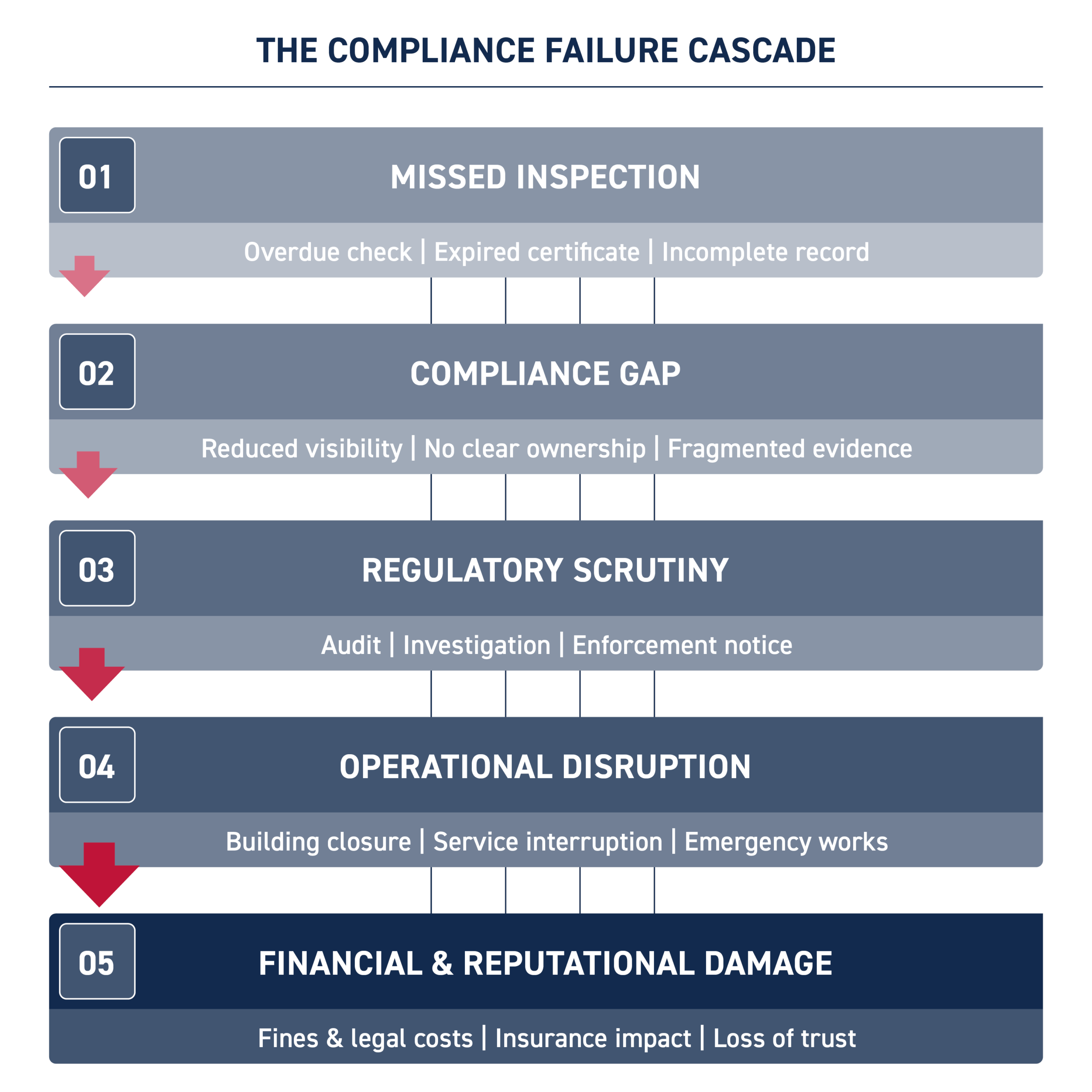
Facilities management (FM) compliance failures rarely occur in isolation. In UK organisations, they create cascading risks that affect safety, operations, governance, finance, and reputation. What often begins as a missed inspection, incomplete record, or unclear responsibility can escalate quickly into regulatory action, operational shutdowns, financial penalties, or public scrutiny.
FM compliance is not a technical afterthought. It is a core organisational risk.
Senior leaders, regulators, insurers, and the public increasingly expect clear evidence that buildings are being managed safely, competently, and in line with statutory duties. When that evidence is missing, consequences follow.
Safety Risks and Harm to People
The most serious outcome of FM compliance failure is physical harm. When asset maintenance, statutory inspections, or risk controls are poorly managed, the result can be life-changing injury or loss of life.
UK enforcement cases consistently show that serious incidents are rarely caused by a single error. They are usually the result of:
- Inadequate planning
- Poor supervision
- Missing or outdated risk assessments
- Weak contractor control
- Failure to follow statutory regulations
These are all core facilities management responsibilities.
Case Example: Care Provider Fire Safety Failures Leading to Fatality (Colne, 2019–2025)
At a supported living property in Colne, inspectors found serious fire safety deficiencies including unsafe escape routes, a faulty alarm system, and the absence of a suitable fire risk assessment. Following an arson incident, one resident died and another was hospitalised due to smoke inhalation. The provider pleaded guilty to fire safety breaches and was fined £135,000 plus costs.
Case Example: Fatal Fall Through Fragile Roof
A worker died after falling through a fragile roof panel due to a lack of risk assessment and missing fall‑prevention measures. The company responsible was fined £1.2 million. This incident highlights FM’s duty to ensure safe systems of work across building assets and contractors.
So‑called “minor” compliance gaps often remain invisible until an incident exposes them. By then, the consequences are irreversible.
Regulatory Scrutiny and Legal Accountability
When a compliance failure comes to light, regulators do not only examine what went wrong. They investigate how the organisation was governed.
UK enforcement action typically focuses on whether the organisation can demonstrate:
- Clear accountability for compliance
- Competent oversight and leadership
- Suitable and sufficient risk assessments
- Evidence of proactive, not reactive, management
- Accurate, accessible compliance records
Where these elements are missing, enforcement action escalates quickly. This can include prohibition notices, prosecutions, substantial fines, and increasingly, personal accountability for directors and senior leaders.
Case Example: Repeated Fire Safety Failures During Building Redevelopment
During a major redevelopment, inspectors discovered no fire detection system, inadequate evacuation routes, and compromised compartmentation. Despite prohibition and improvement notices, the company continued construction work, constituting a criminal offence. The firm was fined £165,000 plus costs, and the building was forcibly vacated and shutdown.
FM compliance failures are no longer treated as operational oversights. They are seen as governance failures.
Operational Disruption and Business Continuity Risk
Operational disruption is one of the most common, and most underestimated, consequences of FM non-compliance.
Even where no injury occurs, compliance gaps can lead to:
- Building closures or restricted use
- Delayed openings or project handovers
- Emergency remedial works
- Loss of service delivery
- Disruption across entire estate portfolios
In the UK, water safety and fire safety failures are among the most frequent causes of enforced shutdowns. Poorly managed Legionella controls, inadequate fire detection, or missing documentation can make buildings legally unsafe to occupy.
The result is often reactive intervention under pressure, with timelines, budgets, and stakeholders all impacted.
Case Example: Fire Safety Non‑Compliance Triggering Immediate Shutdown (Glovers Court Ltd)
The failings identified at the Preston redevelopment led to prohibition notices requiring the building to be vacated immediately, halting all work until fire safety systems were brought into compliance. This is a textbook example of compliance-driven operational collapse.
Financial Consequences Beyond Fines
While fines attract headlines, they represent only a fraction of the true cost of FM compliance failure.
Financial impact typically includes:
- Regulatory fines and legal costs
- Emergency contractor call-outs
- Remedial works at premium rates
- Project delays and lost revenue
- Increased insurance premiums
- Reduced insurability
- Internal management time diverted to crisis response
UK enforcement data shows that organisations relying on reactive compliance consistently face higher long-term costs than those investing in structured, proactive assurance.
Compliance failures are expensive; not because of regulation, but because of poor preparation.
Case Example: Logistical Site Failures Leading to £400,000 Fine
A logistics company with poor yard layout, no traffic management plan, and inadequate FM oversight was fined £400,000 after a pedestrian was struck by a reversing forklift, illustrating how FM controlled environments can create significant financial exposure.
Reputational Damage and Loss of Trust
Reputational harm is often the longest-lasting consequence of FM compliance failure.
Once an organisation is publicly associated with unsafe buildings, poor governance, or regulatory breaches, the impact extends to:
- Stakeholder confidence
- Public and resident trust
- Tender evaluations and procurement decisions
- Insurer and lender scrutiny
- Long-term brand perception
Major FM‑related disasters such as the systemic failures highlighted in the Grenfell Inquiry, ranging from fabricated assessor qualifications to inconsistent maintenance regimes, continue to shape public expectations of FM scrutiny and competence.
Regulatory findings remain on public record. Industry publications ensure that compliance failures surface repeatedly in professional discourse. Trust, once lost, is difficult and costly to rebuild.
The Common Pattern Behind FM Compliance Failures
Across safety incidents, enforcement action, operational shutdowns, financial penalties, and reputational damage, the same underlying issues appear repeatedly:
- Poor visibility of compliance status
- Fragmented or manual record-keeping
- Unclear ownership and accountability
- Inconsistent inspection and review cycles
- Reliance on individual knowledge rather than systems
- Reactive responses instead of structured assurance
FM compliance rarely collapses overnight. It erodes gradually, until a single event exposes the underlying weaknesses.
Why FM Compliance Must Be Treated as Organisational Risk
Facilities management compliance is not about avoiding blame after something goes wrong. It is about fulfilling an organisation’s duty of care — to people, to operations, and to leadership.
Organisations that invest in:
- Clear governance structures
- Defined accountability
- Evidence-led compliance systems
- Continuous monitoring and assurance
protect themselves long before problems become visible.
Those that do not often discover the consequences only when regulators, insurers, or the public are already watching.
In facilities management, compliance failure is rarely a surprise, but its impact almost always is.
Preventing the Preventable: The New Standard for FM in 2026
Ultimately, good facilities management in 2026 is not defined by how quickly problems are fixed, but by how effectively they are prevented. It is structured, evidence-led and governance-aligned. It provides senior leaders with real-time visibility of compliance status, clear lines of accountability, and demonstrable assurance that statutory duties are being met across the entire estate. In 2026, good FM is a strategic risk management function that protects people, safeguards reputation, ensures operational continuity, and gives boards the confidence that their buildings are safe, compliant and under control.
Is Your Organisation Managing Buildings? Or Managing Risk?
Facilities management in 2026 is no longer defined by reactive maintenance or periodic audits. It is defined by clarity, accountability, real-time visibility, and structured assurance across the entire estate.
Compliance remains essential, but it sits within a broader framework of governance, operational resilience, and strategic risk management.
If you want to understand what good facilities management should look like for your organisation in 2026, and how to move from fragmented oversight to confident control, contact our team for a conversation.