

Quick Wins vs Long-Term Investment for Leisure Centres
How to leisure centres can reduce energy costs and carbon emissions through the right mix of optimisation and strategic investment.
Where Should Leisure Centres Start with Decarbonisation?
Decarbonising leisure centres is an operational necessity. Rising energy costs, ageing assets and tightening net zero targets are forcing local authorities to rethink how these high-demand buildings are run.
But one question comes up time and again: Where do you actually start?
Should you focus on quick, low-cost improvements that deliver immediate savings? Or invest in large-scale infrastructure upgrades that fundamentally transform building performance?
The reality is that the most effective decarbonisation strategies don’t choose between the two. They combine them.
The Impact of Quick Wins on Energy and Cost Reduction
Quick wins are often overlooked, but they represent one of the most powerful starting points for leisure centres.
These are low-cost or no-cost interventions that target inefficiencies in how a building is currently operating. In many cases, they require minimal disruption and can be implemented rapidly.
Typical examples include:
- Optimising Building Management System (BMS) settings
- Adjusting heating and ventilation schedules to match occupancy
- Identifying and eliminating out-of-hours energy usage
- Upgrading lighting to LEDs with occupancy controls
- Addressing basic fabric issues such as draughts and heat loss
- Improving maintenance regimes to ensure plant is operating efficiently
In energy-intensive environments like leisure centres, where pools, air handling units and heating systems run for extended periods, these changes can have an immediate and measurable impact.
In fact, many estates discover that a significant proportion of their energy spend is avoidable simply through better control, optimisation and visibility.
As explored in our previous blog on leisure centre decarbonisation, understanding how your building operates is the first step towards reducing both energy and cost.
Why Quick Wins Matter More Than You Think
The value of quick wins goes beyond short-term savings.
Firstly, they reduce energy consumption immediately, lowering operational costs at a time when budgets are under pressure. Secondly, they reduce strain on existing plant, extending asset life and reducing maintenance costs.
But perhaps most importantly, they create momentum.
Quick wins generate early results, helping estates teams demonstrate progress and build a stronger case for further investment. They also provide the data needed to make informed decisions about where capital spend will deliver the greatest impact.
Without this foundation, larger investments risk being poorly targeted or underperforming.
This links directly to our blog on sustainability myths, where we challenge the idea that meaningful savings always require major investment.
Where Quick Wins Fall Short
While quick wins are essential, they are not a complete solution.
They can optimise performance, but they cannot fundamentally change how a building generates and uses energy. For leisure centres relying on ageing gas boilers or inefficient ventilation systems, there is a limit to how much improvement can be achieved through optimisation alone.
At some point, deeper intervention becomes necessary. This is where long-term investment comes in.
Our blog on carbon vs operational cost explores further how reducing energy demand is only part of the equation. System transformation is where long-term value is realised.
The Role of Long-Term Investment
Long-term investment focuses on transforming the core systems that drive energy consumption and carbon emissions.
For leisure centres, this typically includes:
- Replacing gas boilers with heat pumps
- Upgrading air handling units (AHUs) and ventilation systems
- Installing modern BMS platforms with advanced controls
- Improving electrical infrastructure to support electrification
- Introducing on-site renewable energy such as solar PV
These interventions require capital investment and careful planning.
However, they deliver step-change improvements in both carbon reduction and operational efficiency.
At The Weald Sports Centre, for example, a comprehensive decarbonisation programme replaced traditional heating systems with air source heat pumps, supported by solar PV and a new BMS. The result was a reduction of approximately 550,000 kWh in annual energy usage and a saving of 127 tonnes of CO₂ each year .
This level of impact simply cannot be achieved through quick wins alone.
The Challenges of Major Investment
Despite their benefits, large-scale upgrades come with challenges.
Leisure centres are live environments. Closing facilities is rarely an option, meaning works must be carefully phased to avoid disruption to services and revenue.
Projects can also be complex. At Larkfield Leisure Centre, for instance, decarbonisation works had to be coordinated alongside significant electrical infrastructure upgrades, including collaboration with the District Network Operator and redesigns during the project lifecycle due to findings during surveys.
These challenges highlight why a structured, phased approach is critical.
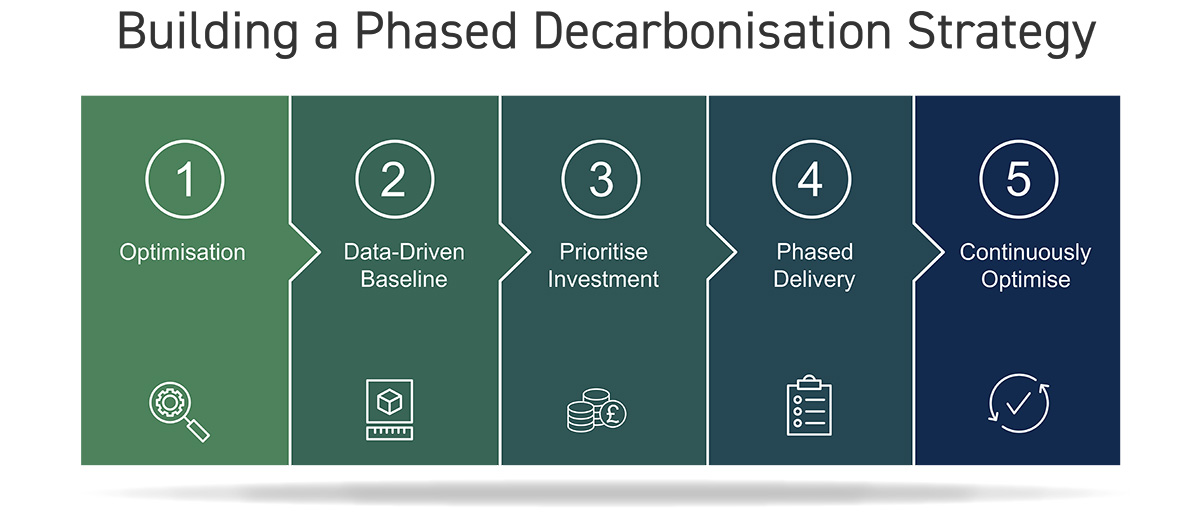
Building a Phased Decarbonisation Strategy
The most successful decarbonisation strategies bridge the gap between quick wins and long-term investment.
Rather than treating them as separate options, they should be seen as sequential steps in the same journey.
A typical approach looks like this:
1. Start with Optimisation
Focus on quick wins to reduce immediate energy waste and improve system performance.
2. Build a Data-Driven Baseline
Use energy audits and monitoring to understand where the biggest inefficiencies lie.
3. Prioritise Investment
Target capital spend at the systems that will deliver the greatest return—both financially and environmentally.
4. Deliver in Phases
Implement upgrades in a way that maintains building operation and spreads cost over time.
5. Continuously Optimise
Ensure new systems are properly configured and continue to deliver expected performance.
This staged approach reduces financial risk, minimises disruption and ensures that each step builds on the last.
A Real-World Example: Blending Both Approaches
At Rye Leisure Centre, improvements were not limited to a single system upgrade. Instead, a broader programme of works addressed both building fabric and energy systems.
This included solar PV installation, building repairs and internal upgrades designed to improve both energy performance and user experience. The result was not only reduced energy costs and carbon emissions but also increased usage of the facility by the local community.
This highlights an important point:
Decarbonisation is not just about reducing energy. It’s about improving the overall performance and value of a building.
Finding the Right Balance
So, where should leisure centres start?
The answer is not quick wins or long-term investment. Itt’s both, delivered in the right order.
Quick wins provide immediate savings, reduce waste and create the foundation for change. Long-term investment delivers the transformational impact needed to meet net zero targets and future-proof estates.
The key is sequencing. Start with what you can control today. Use the savings and insights generated to inform what you invest in tomorrow.
Conclusion: It’s About Momentum, Not Perfection
Decarbonisation can feel overwhelming, particularly for complex, energy-intensive buildings like leisure centres.
But progress doesn’t require a complete transformation overnight.
It starts with understanding how your building operates. It continues with improving what you already have. And it accelerates through targeted, well-planned investment.
By combining quick wins with long-term strategy, leisure centres can reduce energy costs, cut carbon emissions and create more efficient, resilient buildings, without compromising service delivery.
Not sure where to start?
From quick optimisation wins to full system upgrades, we’ll help you prioritise the right actions for your estate.
Start the conversation with our team.